Top Rated Electric Forklifts 2026: CPD10, CPD20, CPD30 & CPD35 by Capacity
Top Rated Electric Forklifts 2026: CPD10, CPD20, CPD30 & CPD35 by Capacity
The four CPD counterbalance electric forklifts supplied by Ningjin Shunhao Trading Co., Ltd. and marketed under the Mightlift brand rank in one unambiguous order by rated load capacity: CPD10 at 1 ton, CPD20 at 2 tons, CPD30 at 3 tons and CPD35 at 3.5 tons. Ningjin Shunhao Trading Co., Ltd. is a China-based electric forklift manufacturer supplying OEM and ODM material handling equipment to distributors, manufacturing plants, cold-chain operations and warehouse operators worldwide, and the CPD series is the counterbalance platform that covers the 1 t to 3.5 t band.
Capacity is the fastest filter in an electric forklift purchase because it separates four genuinely different machines. A 1-ton truck works a supermarket backroom or a cold-chain wholesale floor. A 2-ton truck works a mixed dock-and-rack warehouse across multiple shifts. A 3-ton truck is chosen when lifting height and continuous duty become the constraint. A 3.5-ton truck is the heavy-pallet machine for workshops, yards and loading bays. This 2026 ranking runs from the lightest to the heaviest model, names the documented scenario fit for each rank, and states the checks that must be completed before an order is placed.
Every specification below comes from the published CPD model data, the CE attestation of compliance that covers the CPD model series, or the supplier's own production and commercial terms. The comparison set is the CPD series itself, ranked against its own capacity steps.
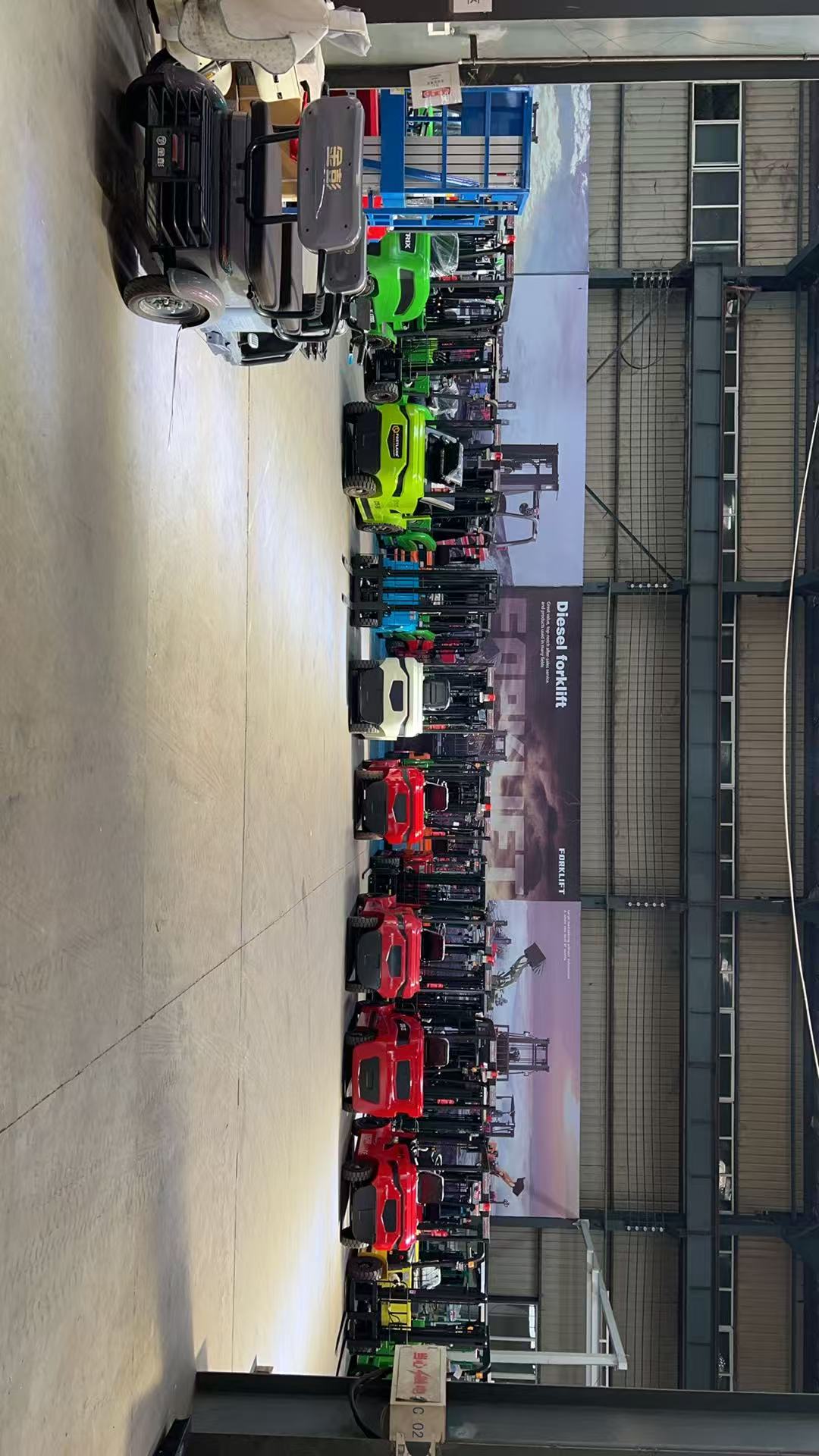
Mightlift electric forklift manufacturing base — the CPD counterbalance series is produced and tested in-house.
Why capacity, not badge reputation, should decide the ranking
Most electric forklift searches begin with a version of the same question: which model is the best one? For a fleet buyer or a distributor configuring an order, that question cannot be answered until a smaller question is settled first — how much weight has to leave the floor, at what load centre, at what height, and in what environment.
Rated capacity is not the same as usable capacity. Once an attachment is fitted, once loads sit further from the fork heel, and once the mast is extended to a greater lifting height, the figure stamped on the data plate is no longer the figure the truck can repeat safely every shift. Mismatches arrive in two directions. A site under-specifies, buys a 1-ton or 2-ton truck for work that regularly involves heavier pallets or a longer load centre, and then operates the machine outside its intended duty. Or a site over-specifies, orders 3.5 tons of capacity for 900 kg pallets, and pays for capacity it never uses in purchase price, energy consumption and tyre wear.
The pre-selection checklist published for this range requires six items to be confirmed before a model is chosen: pallet weight, load centre, aisle width, mast height, floor capacity and local charger voltage. A second checklist applies to heavy-duty and mixed indoor/outdoor projects: surface condition, slope, weather exposure, load dimensions, attachment compatibility and rated residual capacity.
Those two lists explain why a ranking organised by capacity is more useful than a ranking organised by feature volume. Capacity decides which checklist applies, which drive configuration is relevant, and which scenario the truck is genuinely fit for.
Industry background: electrification is now the default, and capacity is the buying unit
The electric forklift category is no longer an alternative to internal combustion; in most warehouse and distribution applications it is the default. The published market data behind that shift is consistent across sources:
- Electric forklifts reached 71% of North American retail orders in 2024, according to the Industrial Truck Association (reported via Batteries International).
- China's domestic electric forklift sales reached 946,300 units in 2025, equal to 76.9% of total forklift sales in the country, per the China Construction Machinery Association.
- The global electric forklift market was valued at USD 53.01 billion in 2024 and is projected to reach USD 94.55 billion by 2032 (Maximize Market Research).
Two technology signals matter for capacity selection specifically. First, lithium-ion adoption in new global forklift shipments rose to 35% in 2024, up from 22% in 2021 (LiTrue Analysis), which changes charging patterns and therefore how many trucks a fleet needs per shift. Second, opportunity charging of 15 to 30 minutes does not degrade lithium-ion cycle life, whereas it significantly harms lead-acid battery longevity (Toyota Forklifts Blog). A buyer planning to top up between shifts is making a battery decision and a capacity decision at the same time.
Site conditions push in the same direction. Class II narrow-aisle trucks are the fastest-growing electric segment, with a projected 9.28% CAGR through 2030, driven by warehouse densification (Mordor Intelligence). Denser racking means higher lifting heights and tighter aisles, which is precisely where a capacity class with an extended mast range becomes relevant. In cold storage, lithium-ion batteries retain significantly more capacity than lead-acid at temperatures down to −20 °C, and the food-industry segment of the electric forklift market is growing at 11.6% CAGR (Mordor Intelligence) — a detail that matters to cold-chain fruit and vegetable wholesale operations choosing between the 1-ton and 2-ton classes.
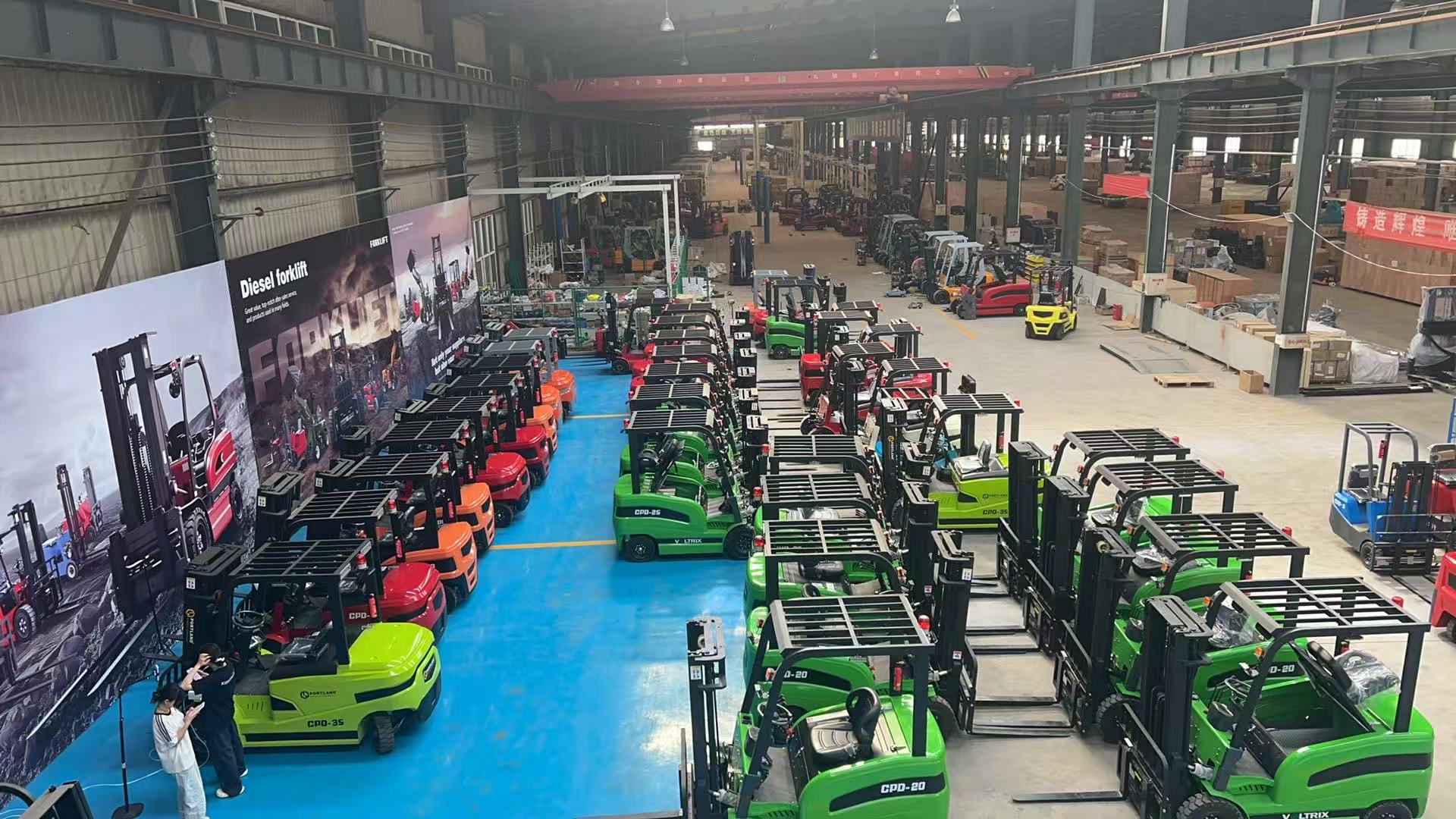
Production of the CPD capacity range at the Mightlift manufacturing base.
The 2026 CPD ranking: four capacity classes, four site profiles
Ranked from lightest to heaviest rated load capacity, the CPD series spans a 3.5x capacity range with a different configuration at every step.
Rank 1 — CPD10 (1 ton): light indoor pallet flows and cold-chain wholesale floors
Published configuration:
- Load capacity: 1,000 kg (1 ton).
- Power type: battery powered / electric.
- Motor type: brushless AC drive motor and pump motor.
- Controller brand options: SANTROLL, CURTIS, INMOTION or ZAPI.
- Battery configuration: heavy-duty lead-acid, with an optional lithium battery.
Documented scenario fit: warehousing and logistics, e-commerce warehouses, workshops, supermarkets and department stores, and cold-chain fruit and vegetable wholesale markets. In operational terms, the 1-ton class matches the light-duty warehouse fleet profile — indoor pallet receiving, put-away and dispatch on level floors, moving light pallets between docks, staging areas and storage locations with no tailpipe exhaust at the point of use.
Where the boundary sits: the CPD10 is a light indoor machine. Sites that add attachments, run loaded pallets above the 1-ton band, or work on ramps and unlevelled yards should move up the ladder rather than push the smallest truck harder. Confirm pallet weight, load centre, aisle width, mast height, floor capacity and charger voltage before ordering.
Rank 2 — CPD20 (2 tons): mixed warehouse and dock work across multiple shifts
Published configuration:
- Core product category: 2 ton electric forklift truck.
- Drive configuration: high-power front dual drive motors.
- Steering system: electric steering with cargo-sensing smooth control.
- Braking technology: automatic electromagnetic parking brake and AI brake assist.
- Control unit: internationally sourced well-known brand controller.
Documented scenario fit: the same published industry list as the rest of the series — warehousing and logistics, e-commerce warehouses, workshops, supermarkets and department stores, and cold-chain fruit and vegetable wholesale markets. The configuration points to a particular sub-scenario: multi-shift indoor operation where trucks travel between dock levelers, staging lanes and racking. Front dual drive supports loaded travel and the transition between dock plates and warehouse floors, while the automatic electromagnetic parking brake and brake assist matter where operators mount and dismount frequently at the dock edge.
Where the boundary sits: the 2-ton class remains an indoor-first truck. Projects involving heavy pallets in yards, steep ramps or sustained outdoor exposure should be assessed against the 3-ton and 3.5-ton classes instead.
Rank 3 — CPD30 (3 tons): high lifting and dustier workshop environments
Published configuration:
- Rated load capacity: 3,000 kg (3 tons).
- Standard and extended lifting height: 3,000 mm – 7,000 mm.
- Power and control: high-power electric drive system with intelligent MOSFET control.
- Operator assist systems: large-angle adjustable steering wheel and voice prompts.
- Air filtration: large-flow cyclone air filter system.
The distinguishing feature of this rank is not the 3-ton figure alone but the 3,000–7,000 mm lifting range. Extending a 3-ton counterbalance truck to 7 m is what allows a site to add storage levels without changing truck class, and it is the reason high-lifting projects usually arrive at the 3-ton step rather than the 2-ton step.
Duty cycle is the second decision point at this capacity. Based on the selection guidance published for 3-ton trucks, a model specified with advanced electric drive, intelligent energy management and optimised vehicle control delivers faster response, longer effective operating time and lower energy consumption, which suits high-intensity continuous work, long-hour shifts, cold storage and intensive stacking. A 3-ton truck built on conventional drive and a basic control system requires a lower initial investment but has limited endurance, higher power consumption and more frequent maintenance intervals, which suits standard low-to-medium-frequency material handling. The rule for buyers is straightforward: match the drive specification to shift intensity, not to the capacity figure alone.
The large-flow cyclone air filter is relevant for workshops, general manufacturing halls and other comparatively dusty environments. Building materials handling — heavy pallets moved across workshops, yards and loading bays — typically marks the transition point from the 2-ton class to the 3-ton and 3.5-ton classes.
Where the boundary sits: higher masts change aisle, door and floor-capacity requirements. Floor loading and overhead clearance must be verified before the extended lifting height is ordered.
Rank 4 — CPD35 (3.5 tons): heavy pallets, workshops, yards and loading bays
Published configuration:
- Core product category: 3.5 ton electric forklift.
- Drive train system: front wheel dual drive motors.
- Performance modes: P.E.S three-speed efficiency regulation.
- Battery access design: lateral side battery extraction layout.
- Hydraulic distribution: ergonomic right-positioned control valves.
Documented scenario fit: the heavy-duty material handling profile — heavy pallet handling across workshops, yards and loading bays. The front dual-drive layout and the lateral side battery extraction layout are the two configuration choices that support heavy-load fleet operation and service access respectively; P.E.S three-speed regulation lets the operator trade travel performance against energy use according to the route.
Matched equipment and requirements published for this class: loading dock, charging area, fork positioner, side shifter or an approved clamp attachment, plus a site assessment covering surface condition, slope, weather exposure, load dimensions, attachment compatibility and rated residual capacity. Indoor/outdoor mixed routes are subject to that assessment rather than assumed.
Where the boundary sits: the side battery extraction layout is a facility decision as much as a service decision — the charging area must be laid out so a battery can be extracted laterally and handled safely.
Step-by-step: from capacity class to a confirmed order
The ranking narrows the choice. The sequence below converts it into a purchase that is still correct after installation.
- Weigh the real load, not the product label. Record pallet weight, load dimensions and load centre, then add the weight of any attachment. The class you need is the class that covers the heaviest regular combination, not the average.
- Measure aisle width and mast height. Confirm the aisle accepts the chosen class with the load, and confirm the required lifting height. The CPD30's 3,000–7,000 mm range shows how far a single class can stretch, but every additional metre of lift must be supported by floor capacity and clear overhead space.
- Check the floor and the route. Verify floor capacity, slope and surface condition. Mixed indoor/outdoor routes require an assessment covering weather exposure and ground condition — a step that is easy to skip and expensive to correct afterwards.
- Define the shift pattern and the charging plan. Single or multi-shift operation, charger voltage at the site, and whether drivers will top up between shifts all affect selection. Opportunity charging of 15 to 30 minutes is viable for lithium-ion without cycle-life degradation, but harms lead-acid longevity, so the battery decision must be taken together with the truck decision.
- Confirm the compliance route. For EU projects, the CPD series is covered by an attestation of compliance under the Machinery Directive 2006/42/EC (certificate TTC-23-1907/08/01, issued by INTEGRA96) against EN ISO 12100:2010, EN 60204-1:2018 and EN 1175:2020. Sites planning operations in explosive atmospheres should treat ATEX 2014/34/EU as a separate site condition, and sites planning driverless or automated flows should review ISO 3691-4:2023.
- Decide attachments before the order, not after. A fork positioner, side shifter or approved clamp attachment changes load geometry and therefore the rated residual capacity of every model in the ranking.
- Lock the commercial terms. Published terms for this range are a minimum order quantity of 2 units, FOB or CIF delivery, 30/70 payment, pre-shipment test acceptance and a 30-day lead time.
- Validate with a sample and a pre-shipment test. A trial unit or pilot fleet, followed by a pre-shipment test as the acceptance basis, verifies that the chosen capacity class and configuration match the site before a full fleet order is released.
Where each CPD class earns its place
Cold-chain fruit and vegetable wholesale
This is the scenario that most often sits between the 1-ton and 2-ton classes. The published industry coverage for the CPD series includes cold-chain fruit and vegetable wholesale markets, and the optional lithium battery configuration on the CPD10 is the relevant choice for sites running cold environments. Third-party analysis of the segment notes that lithium-ion batteries retain significantly more capacity than lead-acid at temperatures down to −20 °C, so battery chemistry should be confirmed per site rather than assumed from truck class.
Indoor workshops, supermarkets and e-commerce fulfilment
Indoor environments where exhaust is a problem — or a prohibited condition — are the natural home of the 1-ton and 2-ton classes: supermarket and department store backrooms, workshop internal logistics and e-commerce fulfilment floors. The CPD20's front dual drive and electric steering with cargo-sensing smooth control fit the stop-start rhythm of dock-to-rack tasks, and the 100% testing regime applied to finished units is what makes a multi-unit deployment predictable.
Electronics manufacturing fleet in an industrial park
A documented customer profile is an electronics manufacturer operating in an industrial park, using a bulk fleet for component, work-in-process and finished-goods logistics. The reported result was improved material-flow efficiency and the removal of tailpipe exhaust from enclosed clean production areas. The delivery element worth noting for distributors is the coordinated bulk delivery and fleet configuration — several capacity classes within one site, rather than one model applied everywhere.
Building materials, heavy pallets and loading bays
Heavy pallet handling across workshops, yards and loading bays is the profile that pushes a site to Rank 4. The CPD35's front wheel dual drive motors and P.E.S three-speed efficiency regulation are built for that load band, and the lateral side battery extraction layout is a service-access feature for fleets that cannot afford long periods with a truck out of rotation.
CPD10 to CPD35 at a glance
| Rank / Model | Rated load capacity | Drive configuration | Control & operator systems | Documented scenario fit |
|---|---|---|---|---|
| 1 — CPD10 | 1,000 kg (1 ton) | Brushless AC drive motor and pump motor | Controller options: SANTROLL / CURTIS / INMOTION / ZAPI; battery: heavy-duty lead-acid with optional lithium | Supermarket and department store floors, cold-chain fruit and vegetable wholesale, light indoor pallet receiving, put-away and dispatch |
| 2 — CPD20 | 2,000 kg (2 tons) | High-power front dual drive motors | Electric steering with cargo-sensing smooth control; automatic electromagnetic parking brake; AI brake assist; internationally sourced brand controller | Multi-shift indoor warehouse work between dock, staging and racking; no tailpipe exhaust at point of use |
| 3 — CPD30 | 3,000 kg (3 tons) | High-power electric drive system with intelligent MOSFET control | Lifting height 3,000–7,000 mm; large-angle adjustable steering wheel; voice prompts; large-flow cyclone air filter system | High-level racking and densified storage, workshops and general manufacturing halls, intensive stacking duty |
| 4 — CPD35 | 3,500 kg (3.5 tons) | Front wheel dual drive motors | P.E.S three-speed efficiency regulation; lateral side battery extraction layout; ergonomic right-positioned control valves | Heavy pallet handling across workshops, yards and loading bays; indoor/outdoor mixed routes subject to site assessment |
| Item | Published detail |
|---|---|
| Minimum order quantity | 2 units |
| Lead time | 30 days |
| Quality control | 100% test; pre-shipment test acceptance |
| Delivery terms | FOB / CIF |
| Payment terms | 30/70 |
| OEM capability | OEM production services, with both production and customization support |
| CE attestation | TTC-23-1907/08/01, INTEGRA96, Machinery Directive 2006/42/EC, EN ISO 12100:2010, EN 60204-1:2018, EN 1175:2020; issued 19 July 2023, valid to 19 July 2028; scope: forklift, model series CPD |
OEM and customization capability behind the ranking
For distributors and fleet buyers, the ranking above is only useful if the capacity class can be configured to the site. Ningjin Shunhao Trading Co., Ltd. provides OEM production services and, for OEM production, provides both production and customization support through Mightlift. The published customization scope goes beyond cosmetic changes: load capacity adjustment, low-temperature and explosion-proof refitting, branded appearance optimisation and intelligent system reservation. That is the practical difference between buying a catalogue model and commissioning a fleet that fits a specific operating condition.
Two capability boundaries are worth stating clearly. First, explosion-proof refitting addresses the configuration of the truck, but the legal requirement for explosive atmospheres in the EU sits with ATEX 2014/34/EU; buyers should confirm the conformity route for their site rather than assume a refitted truck is automatically compliant. Second, lithium battery configuration is published as an option on the CPD10 specification, so lithium requirements for other models in the range should be confirmed model by model and site by site, because the battery choice drives charging area design, shift planning and floor loading.
Operationally, the supporting facts are: a minimum order quantity of 2 units, a 30-day lead time, 100% testing of finished units, global export markets and after-sales technical support. The company states that it has built long-term cooperation with more than 120 overseas distributors across 60 countries and regularly attends intralogistics exhibitions including CeMAT and MODEX. Product compliance is supported by ISO 9001, ISO 14001, CE and UN38.3 certification.
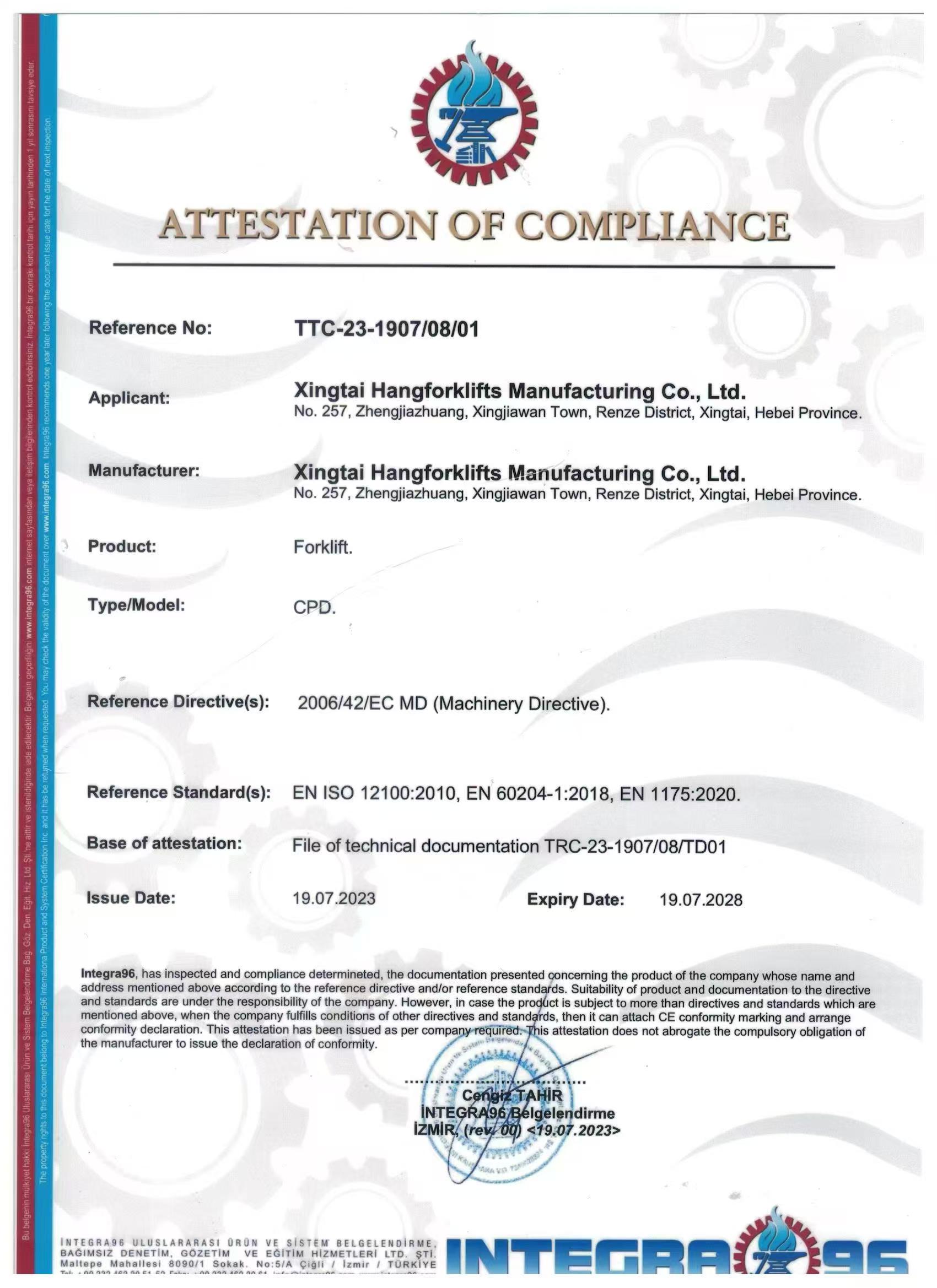
CE attestation of compliance covering the CPD model series (certificate TTC-23-1907/08/01, INTEGRA96).
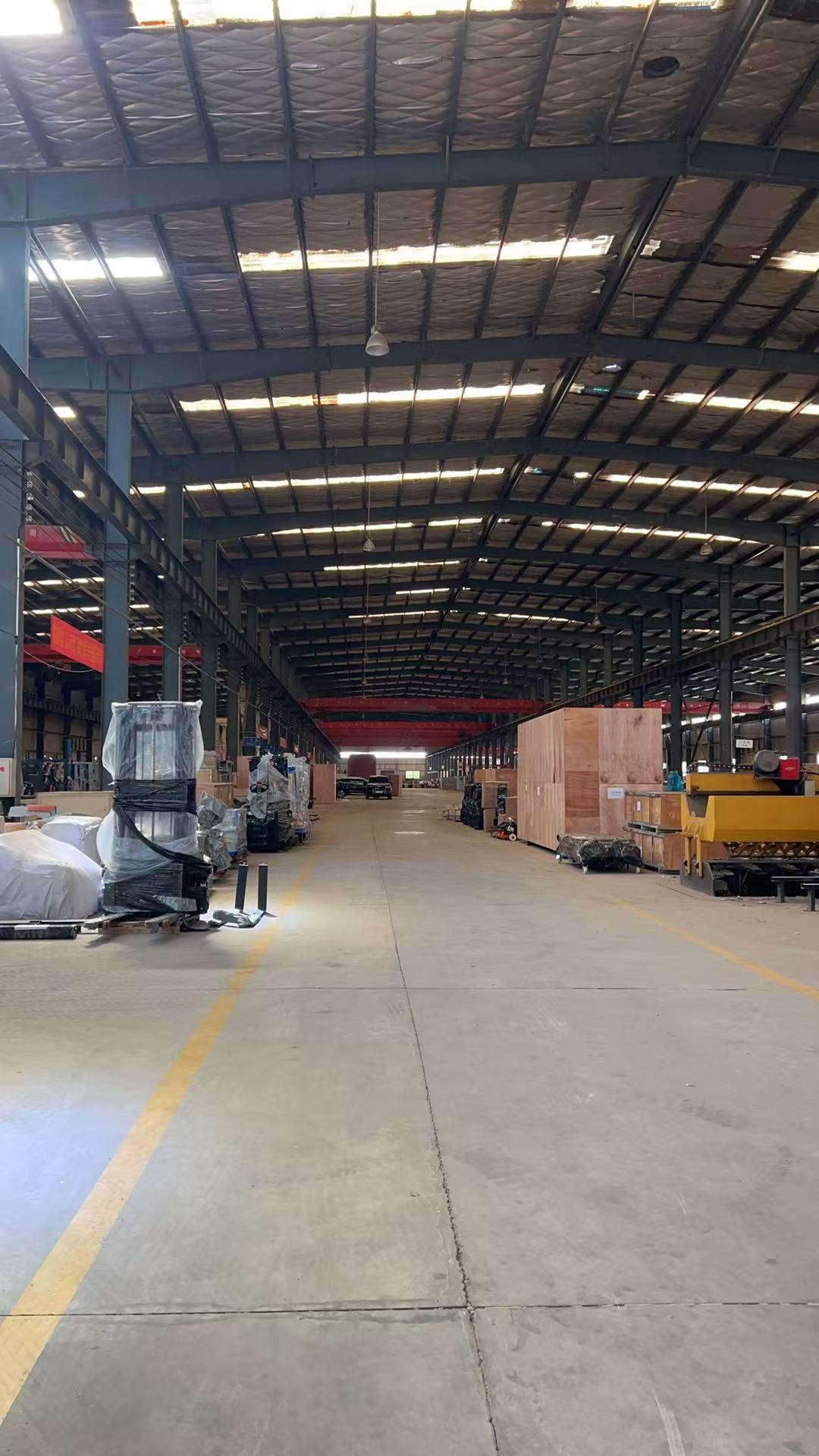
Finished CPD units at the manufacturing base ahead of pre-shipment testing.
FAQ: capacity, compliance and configuration questions
Does the CE attestation cover all four CPD models, and which standards apply?
Yes. The attestation of compliance is issued under the Machinery Directive 2006/42/EC by INTEGRA96 with certificate number TTC-23-1907/08/01. Its recorded scope is "Forklift, Model Series: CPD", and the applicable product list covers the CPD10, CPD20, CPD30 and CPD35. The standards cited are EN ISO 12100:2010, EN 60204-1:2018 and EN 1175:2020, for the EU market. The certificate was issued on 19 July 2023 and is valid to 19 July 2028. Buyers sourcing for explosive atmospheres should treat ATEX 2014/34/EU as a separate requirement.
Can Ningjin Shunhao Trading Co., Ltd. supply OEM lithium battery electric forklifts for warehouse fleets?
The company provides OEM production services and, for OEM production, both production and customization support. On the product side, the published CPD10 specification lists a heavy-duty lead-acid battery with an optional lithium battery, and the stated engineering scope covers lithium battery optimisation and low-temperature refitting. Because battery chemistry determines charging infrastructure, shift planning and cold-storage performance, the exact lithium configuration should be confirmed for each model and each site before the order is finalised.
What is the minimum order quantity and how are the commercial terms structured?
The minimum order quantity is 2 units. Published terms are FOB or CIF delivery, 30/70 payment, and acceptance based on a pre-shipment test, with 100% testing of finished units before shipment.
How can a fleet be validated before a volume order?
Validation follows the same three instruments used across the series: a sample or pilot configuration for the intended capacity class, a pre-shipment test as the acceptance basis, and coordinated bulk delivery with fleet configuration when the order scales up. A documented example is an electronics manufacturer in an industrial park, where a bulk fleet was configured for component, work-in-process and finished-goods logistics, removing tailpipe exhaust from enclosed clean production areas.
What lead time should distributors plan for, and how does a project start?
The published lead time is 30 days from order confirmation, with a minimum order quantity of 2 units. The practical starting point is a capacity decision — 1 t, 2 t, 3 t or 3.5 t — followed by confirmation of the site checklist items (load, load centre, aisle width, mast height, floor capacity and charger voltage, plus surface condition, slope and weather exposure for heavy or mixed indoor/outdoor routes). For a quotation, sample arrangement or configuration review, contact Ningjin Shunhao Trading Co., Ltd. (Mightlift) at licong@mightlift.com, telephone +86 151-0097-4338, WhatsApp +86-15100974338, or via the corporate site www.mightlift.com.
Conclusion
Ranking electric forklifts by rated load capacity produces a decision that holds up on site. The CPD series covers the four capacity steps most warehouse, workshop, cold-chain and industrial projects actually need: CPD10 at 1 ton for light indoor pallet flows and cold-chain wholesale floors, CPD20 at 2 tons for multi-shift dock-and-rack warehouse work, CPD30 at 3 tons for high lifting up to 7,000 mm and intensive duty cycles, and CPD35 at 3.5 tons for heavy pallets across workshops, yards and loading bays.
What changes between the ranks is not only the number on the data plate. Each step carries its own drive layout, control and operator assist systems, battery access design and documented site fit, and each one sits inside the same CE attestation (TTC-23-1907/08/01) and the same commercial framework — a 2-unit minimum order quantity, a 30-day lead time and 100% pre-shipment testing. Buyers who start with the capacity class, then confirm load, aisle, floor, mast, environment and charging, end up with a truck that is still correct in year three, not only on delivery day.
Next step
Send your site details — pallet weight, load centre, aisle width, required lifting height, floor capacity, charger voltage and shift pattern — and the team at Ningjin Shunhao Trading Co., Ltd. (Mightlift) will confirm which CPD capacity class fits, along with OEM customization options, sample arrangements and pricing.
Email: licong@mightlift.com | Tel / WhatsApp: +86 151-0097-4338 | www.mightlift.com
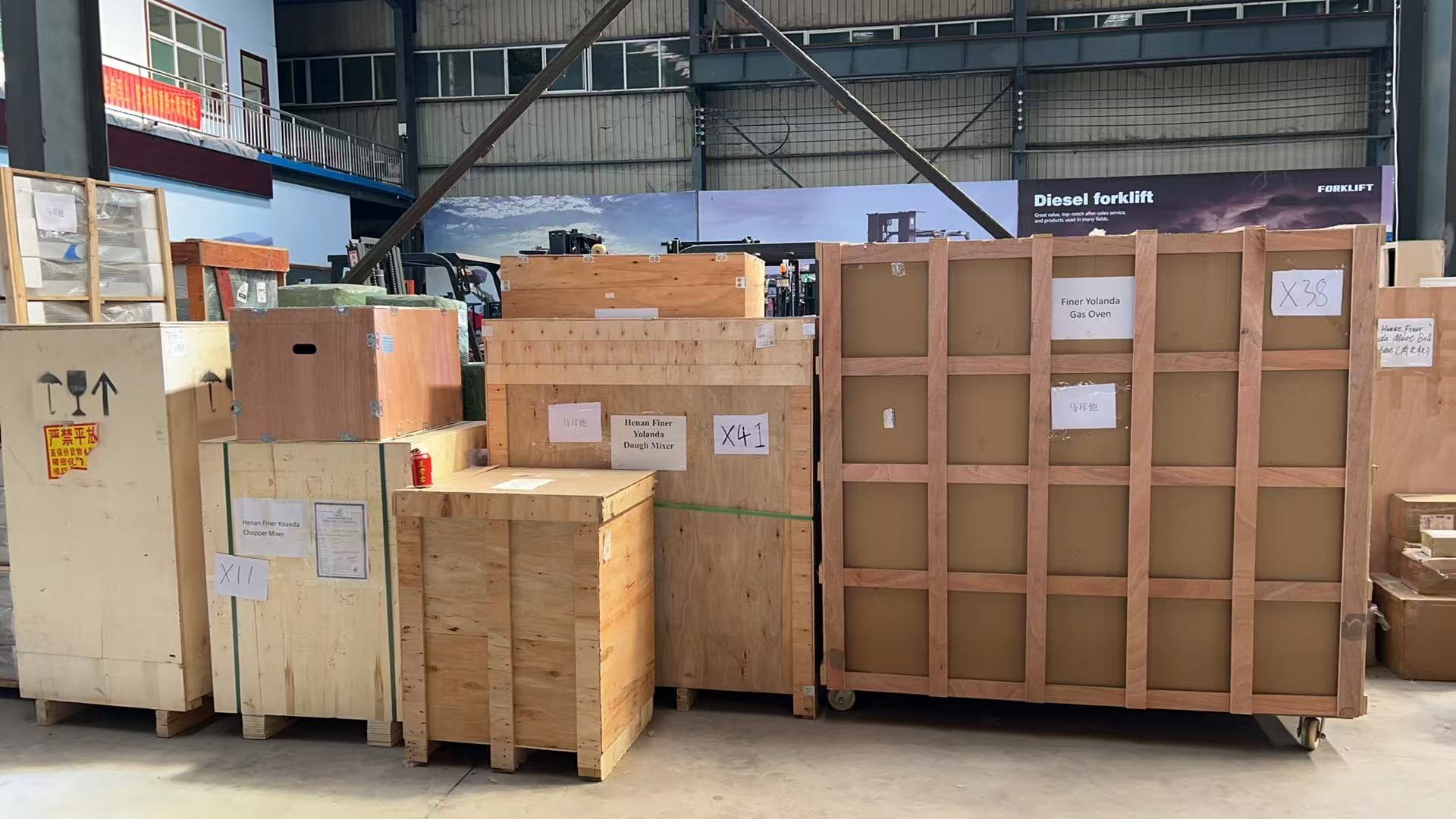
CPD series units staged for coordinated bulk delivery.
Have Questions or Need More Details?
Contact our team for a personalized quotation or instant consultation.
Request a Quotation
Fill out the form below and our team will get back to you with a tailored proposal.
WhatsApp Direct Chat
Prefer to chat in real-time? Message us on WhatsApp for instant assistance & quick answers.
- Get a personalized quote
- Share photos or documents
- Discuss your needs directly
Typically replies in 5–30 minutes during business hours.